



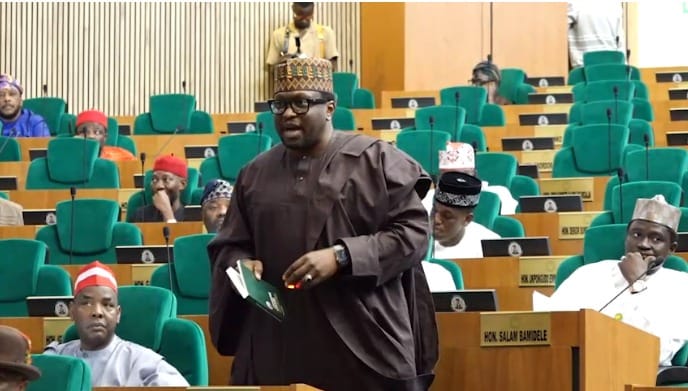
Abdulsammad Dasuki, member of Nigeria’s House of Representatives (PDP, Sokoto)
A quiet storm erupted last week in the halls of Nigeria’s National Assembly. A lawmaker from the opposition People’s Democratic Party (PDP) in the northern state of Sokoto, Hon. Abdulsammad Dasuki, levelled a charge that cut to the heart of democratic integrity. He raised concerns that the Bola Tinubu administration may have quietly altered Nigeria’s tax laws in ways that directly affect citizens’ hard-earned money.
The tax reform laws gazetted by Tinubu’s administration, the legislator claimed, bore little resemblance to the bills painstakingly debated and passed by lawmakers. “I was here, I gave my vote and it was counted, and I am seeing something completely different,” Dasuki said.
The allegation was beyond mere procedural quibbling. It was an accusation of legislative sabotage, one that has ignited a firestorm of controversy over Tinubu’s ambitious tax overhaul, set to take effect on January 1, 2026.
At the core of the dispute are four key acts, the Nigeria Revenue Service (Establishment) Act, the Joint Revenue Board of Nigeria (Establishment) Act, the Nigeria Tax Administration Act, and the Nigeria Tax Act, passed earlier this year against the backdrop of promises of streamlining a bloated, inefficient system.
Tinubu signed them into law on June 26, touting them as vital for boosting revenue in a country grappling with debt and dwindling oil fortunes. But Dasuki, after poring over documents, spotted discrepancies that he argued undermined the entire process.
He called for the House to scrutinise everything, including the harmonised bills, votes and proceedings from both chambers, and the gazetted copies. “This is a breach of the Constitution,” he warned, urging action to prevent laws “different from those duly passed” from being foisted on Nigerians.
The allegations, amplified by outlets like the popular local news platform, Daily Trust, paint a picture of subtle but profound alterations. One such clause of concern was Section 64(1) of the Nigeria Tax Administration Act.
The version approved by the House granted tax authorities the power to investigate violations, a standard tool for compliance checks. But the gazetted law tacked on a chilling addition: the ability to “arrest any person suspected of committing such violations through relevant law enforcement agency.”
Suddenly, a paperwork dispute could escalate to detention without judicial oversight. Other changes follow suit. Garnishment of assets now bypasses court orders in some cases, shifting from requiring High Court approval to allowing tax officials to seize and sell property unilaterally.
Reporting obligations were also altered in relation to petroleum operations. The gazetted version mandates that returns relating to petroleum operations be computed in U.S. dollars, unlike the passed version which allowed computation in the currency of the transaction—a change critics argue exacerbates Nigeria’s foreign exchange challenges.
Appeals against tax decisions demand a 20% deposit of the disputed amount upfront, pricing out many ordinary citizens from seeking justice. Also crucial are provisions mandating quarterly and annual reports to the National Assembly, essential for legislative oversight, which were altered or removed entirely in the gazetted versions.
These are not cosmetic adjustments. They expand executive muscle just as they erode checks and balances. For taxpayers, the implications are stark. There are heightened risks of arbitrary enforcement, eroded rights, and heavier burdens on small businesses already reeling from inflation hovering near 30%.
Economically, while the reforms aim to plug revenue leaks, the uncertainty could spark litigation, deter investment, and widen inequality. As one commentator put it, in a critique of the government’s perceived condescension; “We have every right to ask questions… How can you impose new tax laws when Nigerians are struggling?”
He invoked the chair of the presidential tax committee, Taiwo Oyedele, who has defended the reforms overall and addressed broader concerns.
The backlash has been swift and diverse. The Supreme Council for Shari’ah in Nigeria, a influential Muslim body, issued a scathing statement, decrying the alleged alterations as a “grave and egregious constitutional infraction” that tampers with “the sovereign will of the Nigerian people.” They demanded transparent scrutiny before implementation, warning of eroded public trust and economic instability.
Opposition figures, under the banner of the National Opposition Movement, went further, calling for the laws’ suspension amidst chants of rejection. “These bills will further impoverish Nigerians… The storm is gathering,” it said.
Voices of some popular activists framed the reforms as tone-deaf in a country where citizens patch government failures, fixing roads, buying generators, only to face more levies. The Tinubu administration has defended the laws as properly enacted through constitutional processes, while the allegations remain under investigation by a House ad-hoc committee.
Critics suggest the changes consolidate power, potentially weaponising tax agencies against dissenters, much like the Economic and Financial Crimes Commission has been accused of in the past—though these remain opinions from commentators and analysts.
In a young democracy like Nigeria’s, where trust in institutions is fragile, such controversies are not just about taxes, they are about the soul of governance. Dasuki’s plea is still being debated, as many Nigerians ask if the Assembly will reclaim its authority, or if these shadows deepen the divide between the political leadership and the people. The answer could redefine Tinubu’s legacy, one altered clause at a time.