


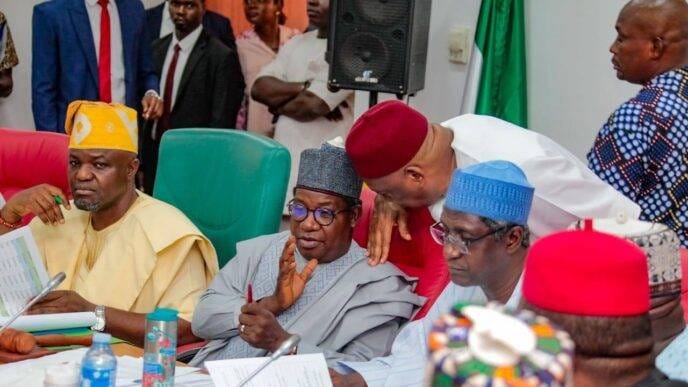
In the committee rooms of Nigeria’s National Assembly, a recurring theme has dominated this year’s budget defence sessions. The stark gap between ambitious spending plans and the funds actually made available to government ministries.
During presentations for the 2026 fiscal year, several ministers have reported receiving only a fraction of their 2025 capital allocations, forcing the rollover of major projects and limiting essential work. The disclosures have highlighted ongoing challenges in budget implementation under President Bola Tinubu’s administration, even as lawmakers prepare to approve the next round of spending.
The country’s ministry of transportation stands as a prominent example. It was allocated N256.73bn for capital projects in 2025, but received just 1%, approximately N2.5bn, according to Senator Saidu Alkali, the minister.
Much of that was not fully cash-backed, he told the joint Senate and House committee on land transport. As a result, about 70% of the ministry’s planned initiatives for 2025 have been deferred to this year, including key elements of the Nigerian Railway Modernisation Programme.
Overhead spending fared better, at around 59%, but agencies under the ministry, such as the Nigerian Railway Corporation and the Nigerian Institute of Transport Technology, received no capital funds at all. They relied on limited overheads for maintenance and rehabilitation.
Similar complaints have echoed across sectors. The Ministry of Health reported receiving only N36m of its N218bn capital budget, stalling projects nationwide. The Ministry of Marine and Blue Economy got about 2% of its allocation.
These figures come against the backdrop of a broader fiscal squeeze. By the third quarter of 2025, the federal government had released roughly 17.7% of the year’s overall capital budget, or N3.1trn.
The administration has pointed to revenue shortfalls as the primary cause. The 2025 budget projected N40.8trn in income to support a N54.9trn “Budget of Restoration”. Actual collections are now expected to reach only about N10.7trn to N20.7trn, officials say, due to underperformance in oil revenues and other streams.
Debt servicing has consumed a large share, N13.69trn in the first 10 months alone, leaving less for capital works. To manage this, the government directed ministries to roll over 70% of 2025 capital projects into 2026, focusing on completing ongoing schemes rather than starting new ones.
In December, Tinubu told the legislature the low releases reflected a deliberate choice to prioritise 2024 projects, whose implementation was extended.
Finance minister, Wale Edun, has emphasised the need for fiscal discipline, revenue growth and public-private partnerships to bridge gaps. In the transport sector, the ministry secured around $200m in private commitments despite the constraints, a point praised by the land transport committee chairman, Senator Adamu Aliero, who called the performance “impressive” under the circumstances.
The pattern has, however, drawn wider concern. Lawmakers on other panels have expressed frustration, with some threatening to withhold funds from the Accountant-General’s office over repeated non-releases.
Analysts describe it as a symptom of deeper issues. Nigeria’s history of optimistic budgeting colliding with volatile revenues, high inflation and naira weakness. One economist noted that while the “Renewed Hope Agenda” promises infrastructure and social investment, execution rates have fallen short, eroding public trust.
The implications extend beyond spreadsheets. Delayed rail and road projects hinder trade and mobility in a country where logistics costs already inflate prices.
In health, limited capital spending hampers efforts to expand primary care and tackle disease outbreaks. Broader economic growth, projected at 4.6% for 2025 but revised down amidst fiscal pressures, suffers when funds for power, housing and agriculture remain unspent.
Public discourse has amplified these worries, with commentators questioning whether the emphasis on debt repayment and recurrent costs leaves too little for development. Civil society groups have urged faster revenue reforms, including improved tax collection and diversification away from oil.
The legislature is working to finalise the 2026 budget, projected at around N58trn, with capital at N26trn, lawmakers say they will push for stricter timelines and accountability. The government has pledged “stronger discipline” this year, vowing full releases in line with appropriations.
For now, the defence sessions serve as a reminder of the gap between legislative ambition and fiscal reality. As the country grapples with insecurity and infrastructure deficits, turning paper allocations into tangible progress remains the central test of governance.


